


Cet article n'est disponible qu'en anglais.
Back to BlogHow We Build Abilities in MISFITZ
Inside Combat Actions, the system our designers use to make abilities without writing new code.
By Joan, Engineer at Antihero Studios
Every character ability in MISFITZ, the social extraction game for mobile we make at Antihero Studios, is assembled from Combat Actions instead of being written by hand. That single decision shapes how fast we can try ideas, how a small team builds a whole cast of characters, and who gets to change an ability once it exists. I'm one of the engineers on the game. This is how the system works, with Ray's main attack as the example.
MISFITZ by Antihero Studios builds its character abilities from Combat Actions: reusable pieces such as shoot, repeat, delay and apply-on-self, nearly all of which can hold other Combat Actions inside them. Designers combine them in an editor, set costs, control types and combat effects, and get a working ability from parts that already exist. Character abilities, passives, power-ups and Trashbots all run on the same system.
Why not hard-code every ability?
Hard-coding turns every idea into an engineering ticket. Plenty of games write custom code for every ability, for characters and enemies alike, and with a handful of abilities that's quick and easy. Over time it becomes the bottleneck. Each time a designer wants to try something new, an engineer has to stop and build it, and the idea waits in line behind everything else. We're a small team with a very long list, so we designed for efficiency from the start. We didn't want each new character to be a project. We wanted it to be an arrangement.
What is a Combat Action?
A Combat Action is one small, reusable thing an ability can do. Shoot a projectile. Charge. Wait. Repeat something. Apply an effect to yourself. Drop an area of effect on the ground. Spawn something. Teleport. When a designer starts a new ability, they see a blank canvas and a list of these to pick from.
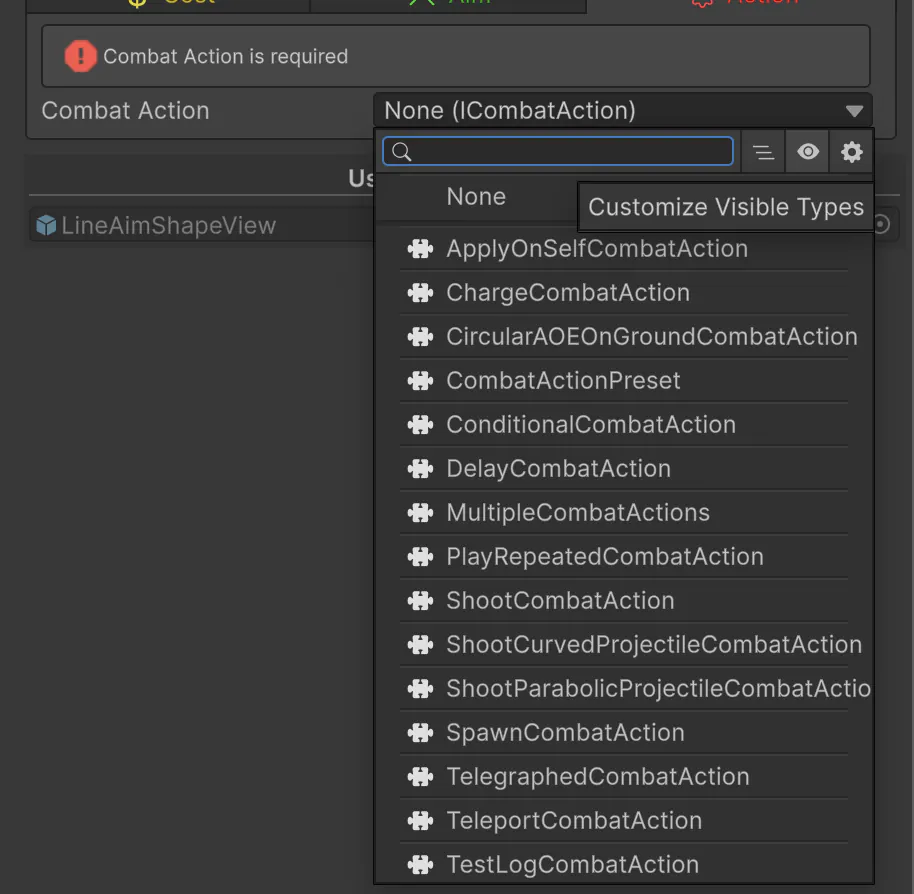
The property that makes the whole thing work is nesting: nearly every Combat Action can trigger other Combat Actions inside it. A shot can carry what happens when it lands. A repeat can wrap a shot. One block can run several actions side by side. Abilities stop being code and become small trees of decisions that a designer can read, change and reuse. That's what makes Combat Actions a data-driven ability system: an ability is data a designer edits, not code an engineer writes.
How do costs and control types work?
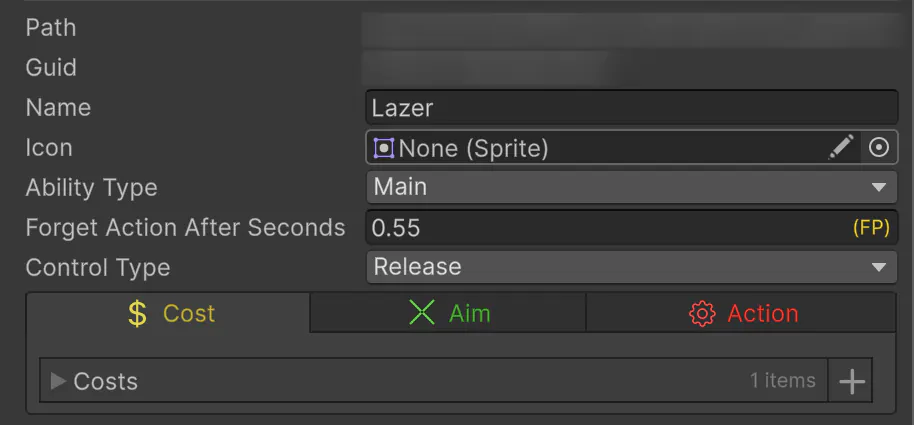
Before any action runs, an ability defines what it costs and how you trigger it. Each ability can have several costs, such as bullets or a plain cooldown. It also has a control type: some abilities fire when you let go of the button, others while you hold it down. Ray's main attack fires when you let go.
How is Ray's main attack built?
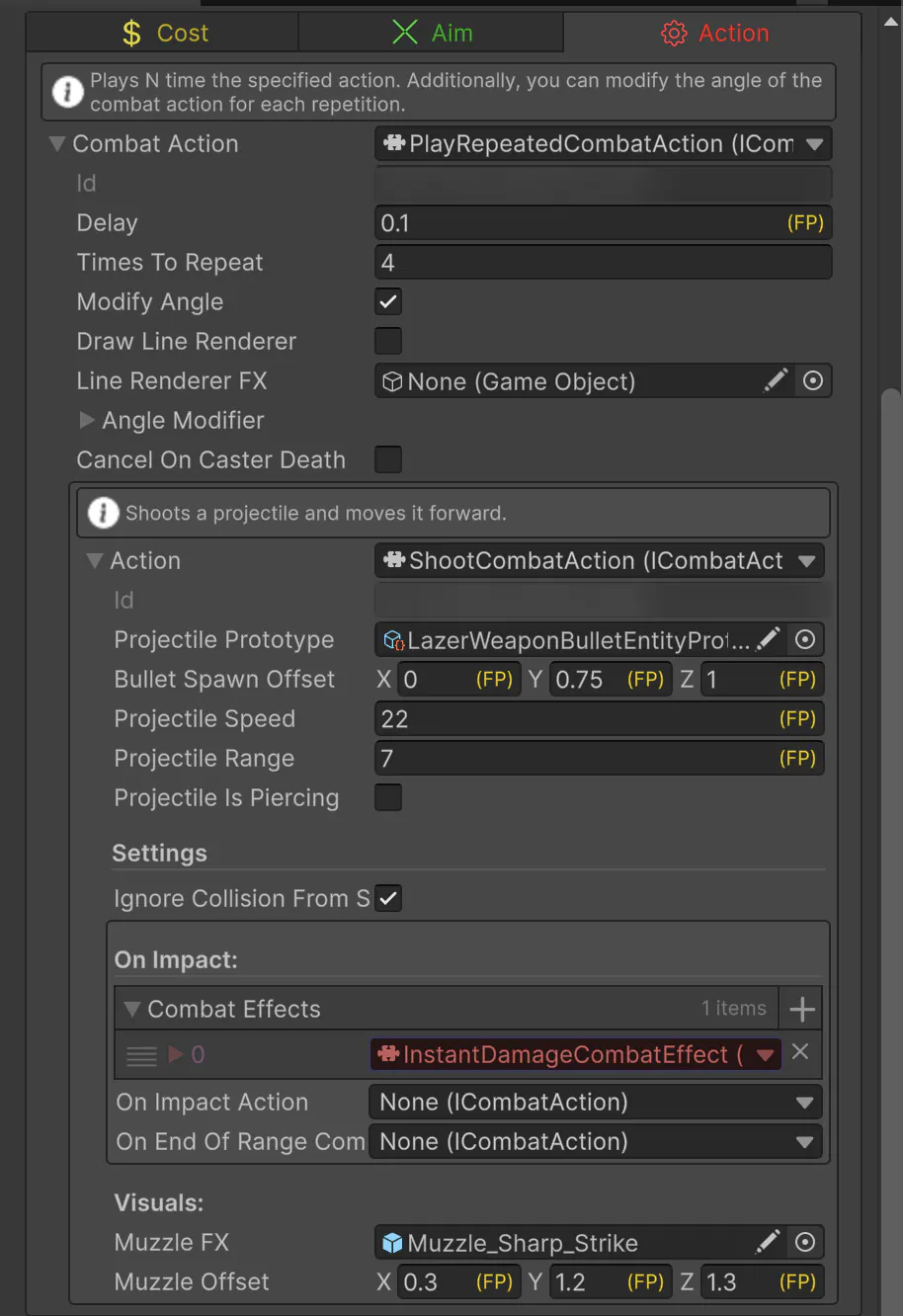
Ray's main attack is a Shoot action wrapped in a Play Repeated action: four shots, a tenth of a second apart, each one carrying its own damage. The character guide describes it as four pure energy blasts in quick succession. Here is what that looks like from the inside, and how you would rebuild it from an empty slot.
Step 1: shoot one bullet
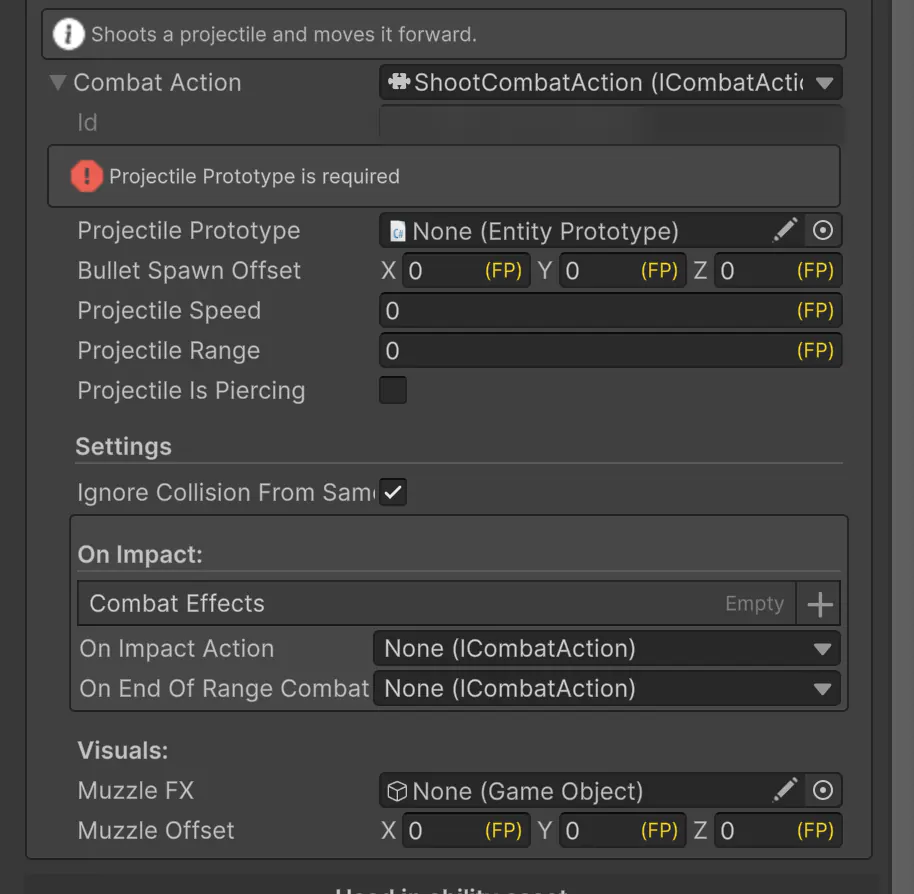
Start simple, with a single Shoot action. The bullet itself defines the visuals and the collider, and the action sets its speed, its range and whether it pierces through targets. The fields worth staring at are near the bottom: an impact action and an end-of-range action. Each one fires a new Combat Action when the bullet hits something or runs out of distance. That could be an area of damage, a spawned Trashbot, or the player teleporting to where the bullet landed. It's up to the designer.
Step 2: decide what a hit does
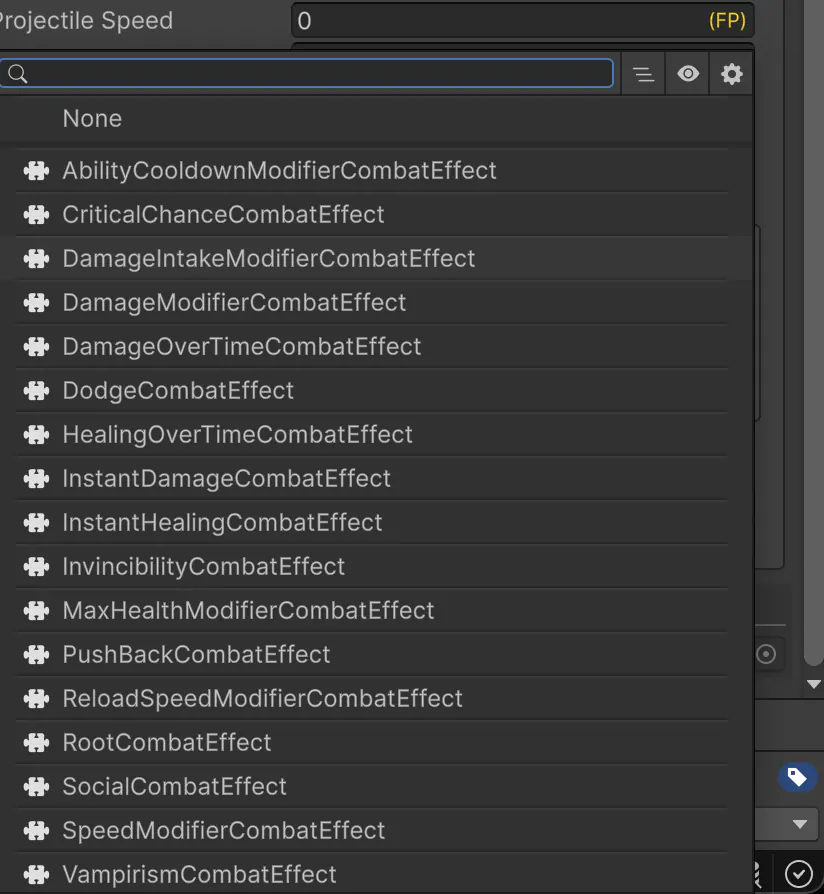
What a bullet does when it connects lives in its combat effects. That's where every status in the game sits: damage, poison, weakness, speed changes and the rest. The list in the picker runs from cooldown changes all the way to vampirism. Each effect has filters that decide who it touches: enemies, yourself, your allies, and more. On Ray's damage effect, "affects own team" and "affects self" are both switched off, which is why his blasts never hurt Ray or his own team.
Step 3: repeat it
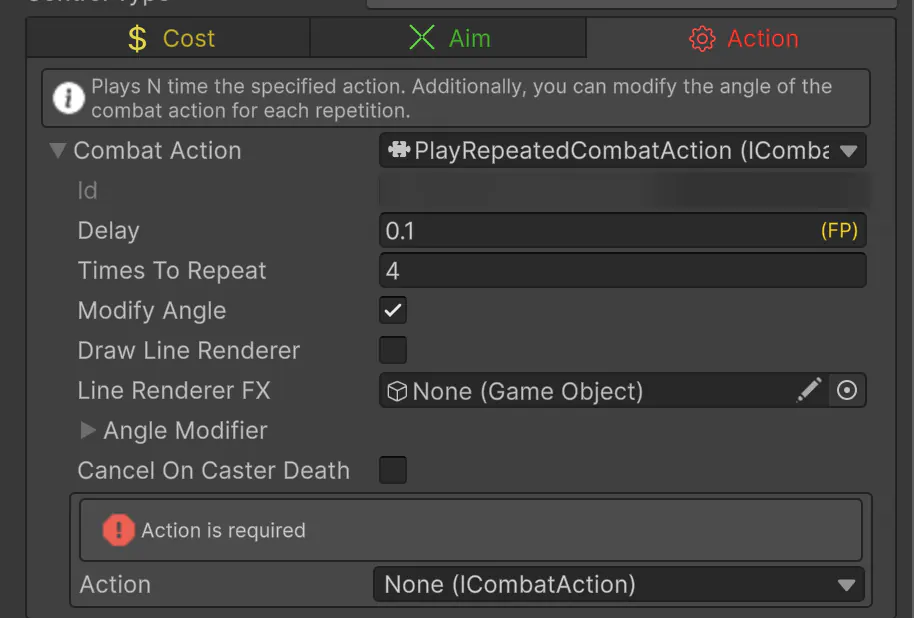
Play Repeated does exactly what its name says: it repeats another Combat Action. You set the delay between repetitions, the number of repetitions, and whether each one nudges the angle slightly. It's perfect for bullets, but it repeats anything, a poison pool included. For Ray it's four repetitions, 0.1 seconds apart, with the angle modified on each one.
Step 4: just shoot
Inside the repeat goes the Shoot action from step one, now dressed as Ray's: his bullet with a little offset, a speed, and a damage effect of 220 per bullet. Four of those, a tenth of a second apart, is the attack. That's the whole ability, made entirely from parts that already existed.
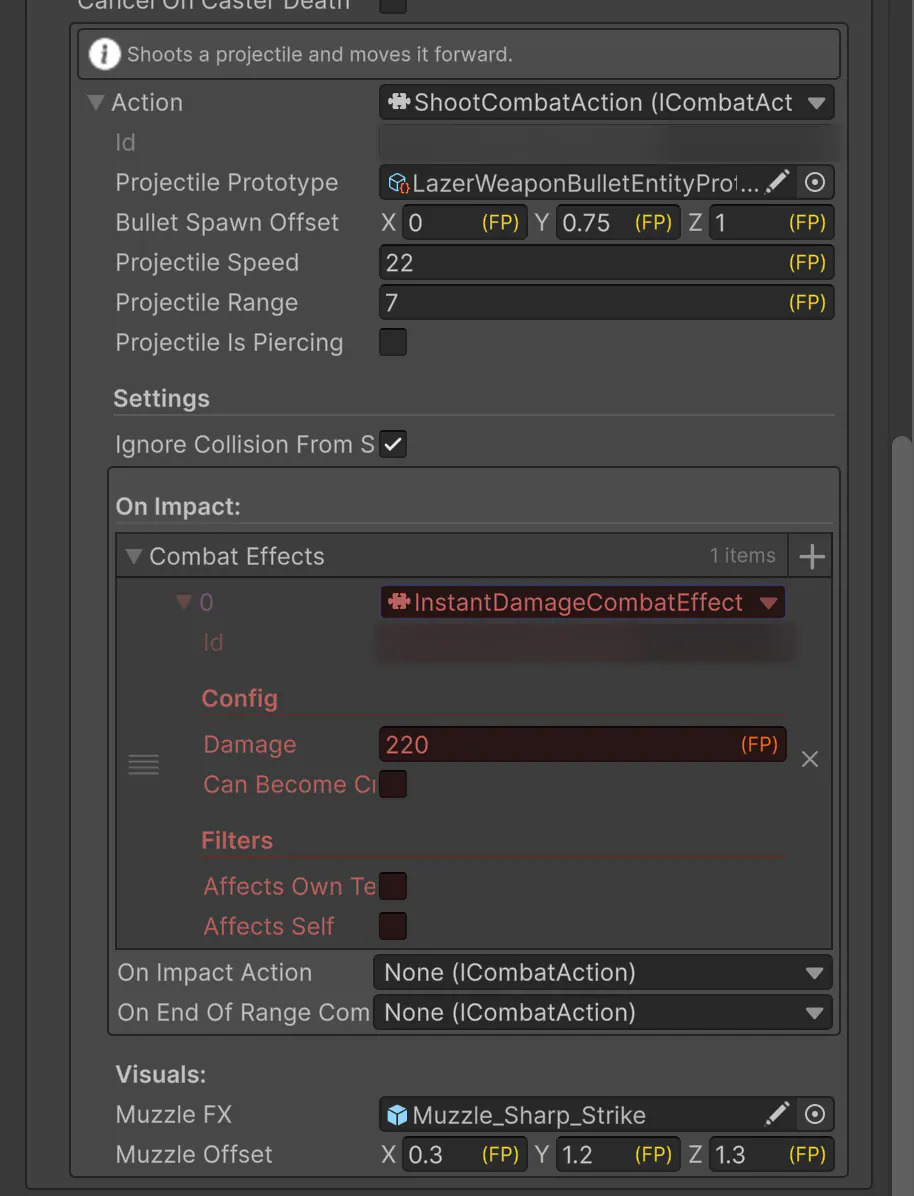
The numbers in these screenshots come from a development build, and balance numbers move all the time. That's exactly why they live in data and not in code.
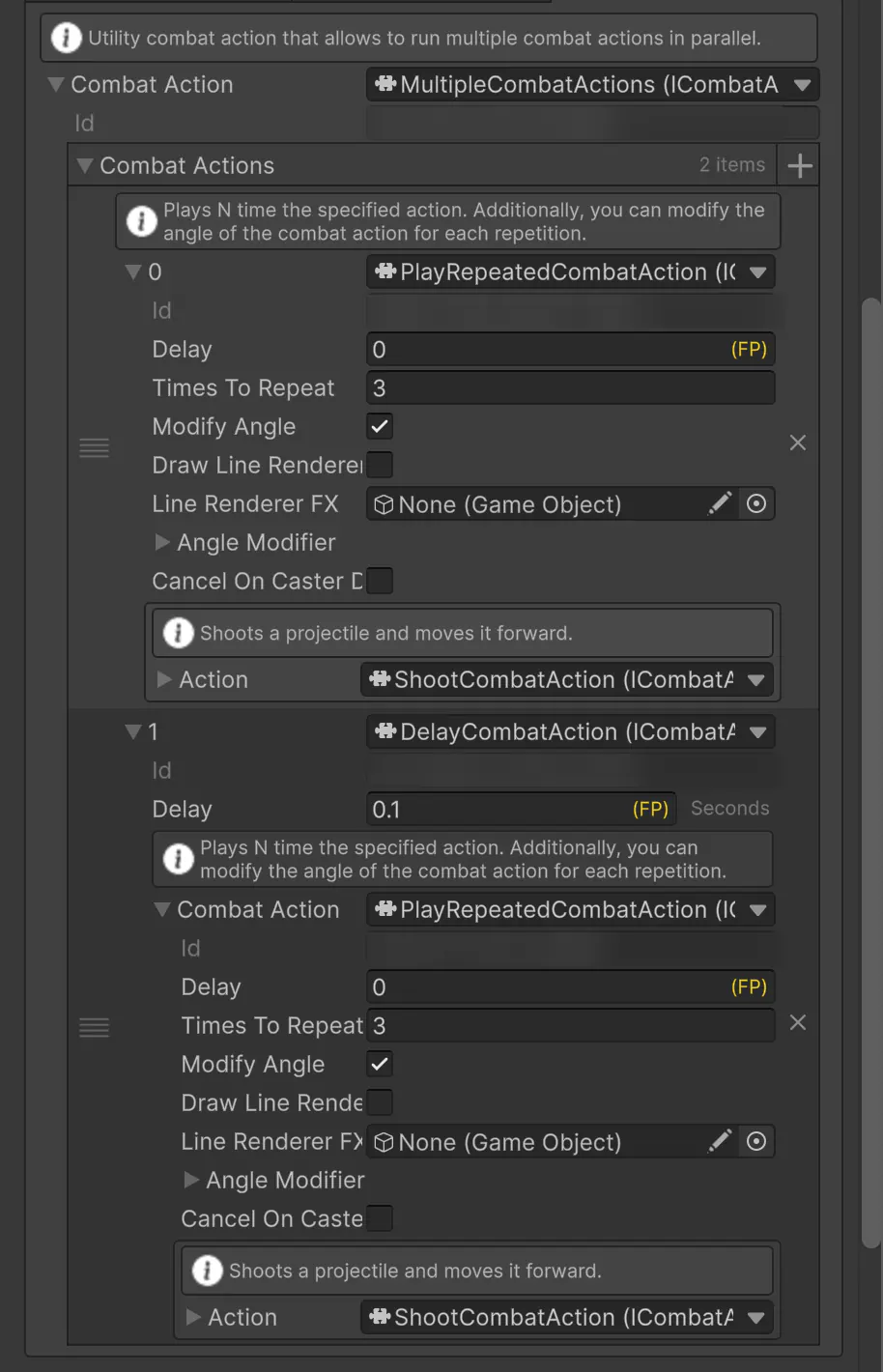
Beat's main attack uses the same parts in a different arrangement. A Multiple Combat Actions block runs two branches side by side: one fires three projectiles at once, each at a slightly different angle, and the other waits a tenth of a second and fires three more. Same pieces, a completely different feel. That's the point.
What else runs on Combat Actions?
Nearly everything that does something in a fight. We kept improving the system after those screenshots, and it spread. Character abilities, passives, the power-ups you pick up during a run and Trashbots all run on Combat Actions now. It has proven flexible enough for everything we wanted from it, and it also gave me a place to play.
How far does the system stretch? Four demos
To test how far the system stretches, I built some new effects that plug into the existing library. The clearest is orbiting projectiles. Everything in this section is a demo of the system, and none of it is an ability in MISFITZ.
In one demo, bullets orbit the player and hit whatever they touch, carrying any effect we already had: damage, healing, paralysis. A second demo uses the same orbit with different bullets, and those bullets stop enemy projectiles instead, which is a shield made out of a bullet swap. A third demo attaches the orbit to a projectile, so effects stack, mix and match: a shot that carries its own ring of shots. The fourth demo is a different kind of effect, a Combat Action that spawns items, so a hit could drop a power-up or a piece of gear.
Why build a node-based editor for designers?
Because a nested list gets hard to read fast. Ray's attack is simple, and its panel already scrolls. Abilities with conditions, branches and chained effects turn into long vertical stacks where it's hard to see what triggers what, and a system people struggle to read is a system they hesitate to touch.
Over a Christmas break I built a side project: the Combat Action Editor, a node-based tool that draws an ability as a graph. Each Combat Action is a node, and wires show what triggers what. Designers can leave notes on the canvas, collapse what they don't need, and see a whole ability on one screen instead of scrolling through it. It's finished, and the team already uses it to understand and iterate on existing Combat Actions and to build new ones.
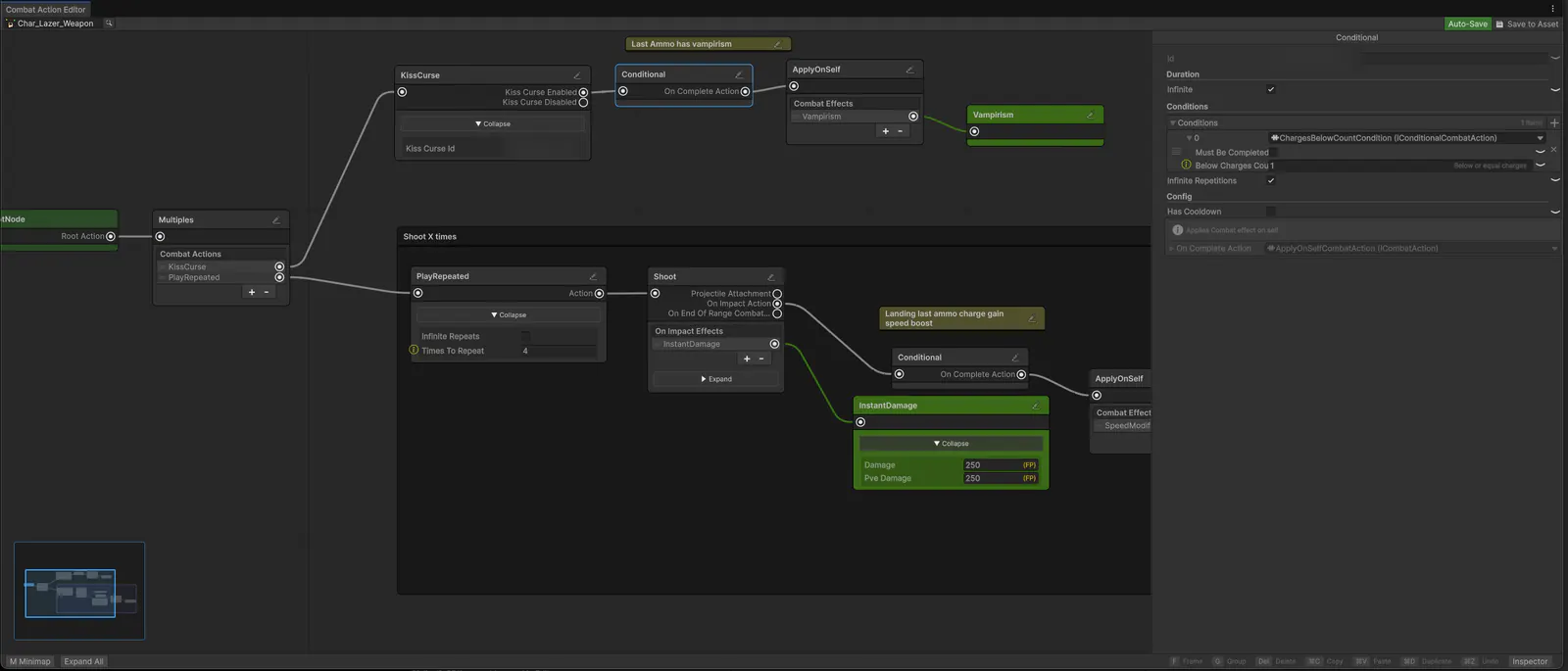
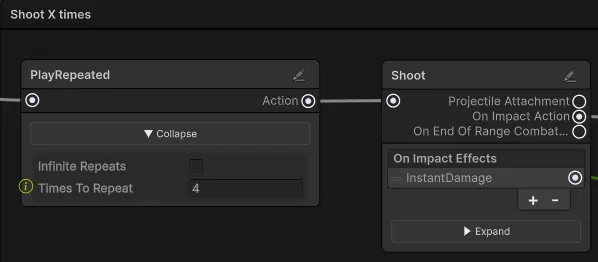
It matters because so much runs through this system: power-ups, passives and every character's abilities. A tool that makes the system faster to read makes all of those faster to change. One detail in that screenshot makes the case better than I can. The damage node reads 250, not 220. Somewhere between the two screenshots Ray was rebalanced, and rebalancing him meant changing a number in a field.
What this lets a small team do
The point was never elegance. It's speed and ownership. When an ability is an arrangement of parts, a designer can try an idea without waiting for an engineer, engineers spend their time building new kinds of parts instead of one-off code, and the people who decide how MISFITZ feels are the ones holding the controls. We believe that's how a small studio builds a game that plays bigger than its headcount: not by working more hours, but by making ideas cheap to try. For the design reasons behind all this, read why abilities carry so much of the depth in MISFITZ, or go meet the characters these systems built.
Ray still fires four blasts. Now you know how.
Adapted from Joan's dev updates in the MISFITZ Discord.
Frequently Asked Questions
How are abilities made in MISFITZ?
Designers build them from Combat Actions, small reusable pieces such as shoot, repeat, delay and apply-on-self that can hold other actions inside them. An ability is an arrangement of parts that already exist, not new code.
What is a data-driven ability system?
An ability system where each ability is data, an arrangement of reusable actions and effects, instead of its own piece of code. In MISFITZ that system is Combat Actions: designers combine pieces like shoot, repeat and delay, and when Ray was rebalanced, it meant changing a number in a field.
How does Ray's main attack work?
It's a Shoot action wrapped in a Play Repeated action: four shots, a tenth of a second apart, each with a slight change of angle and its own damage effect. The damage filters are set so the shots never hurt Ray or his own team.
What else runs on Combat Actions?
In MISFITZ, Combat Actions run character abilities, passives, the power-ups you pick up during a run, and the Trashbots, Zero's bots: nearly everything that does something in a fight.
Are orbiting projectiles an ability in MISFITZ?
No. Orbiting projectiles, projectile-blocking orbits and item spawns were demos built to test the system. None of them are abilities in the game.
What is the Combat Action Editor?
The Combat Action Editor is a node-based tool for MISFITZ designers, built over a Christmas break. It draws each ability as a graph, so designers can see a whole ability on one screen and change it quickly. The team uses it to work on existing and new Combat Actions.
Can designers make abilities without an engineer?
Yes, as long as the ability is made from Combat Actions and effects that already exist. Engineers build new kinds of pieces, like the orbiting effect in the demos, and designers combine them.
Last updated:
See What These Parts Built.
Characters made from Combat Actions, in runs where trust is optional.